AI Multi-Agent Architecture Engine & Spec Generator
Overview
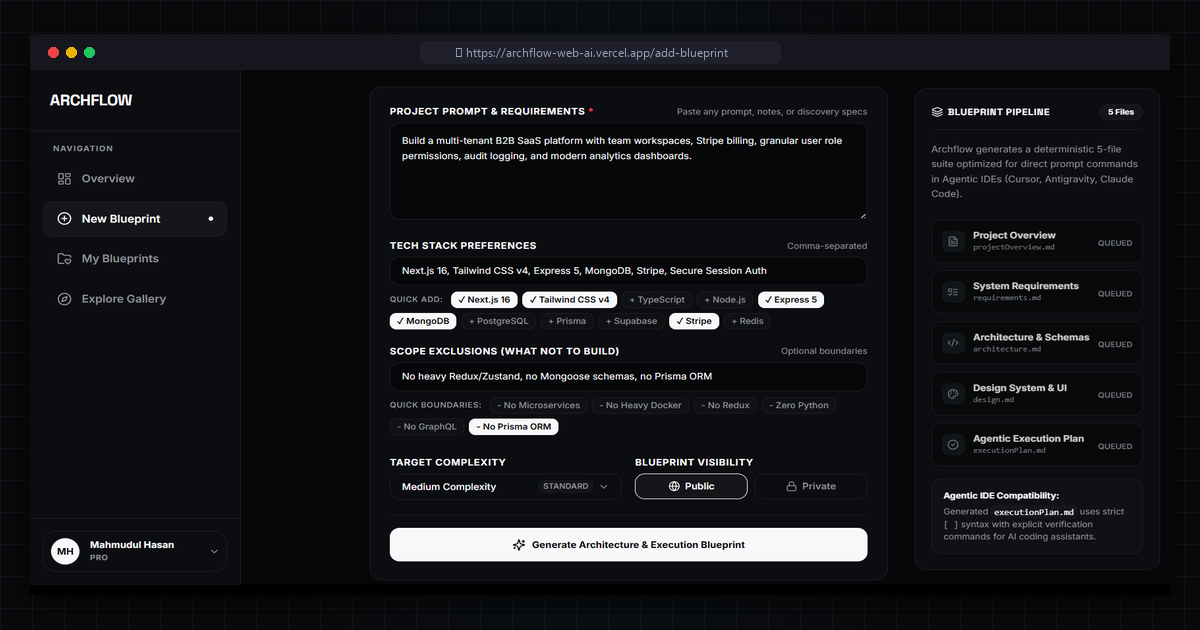
Archflow is an autonomous, agentic software engineering platform built for modern development teams, software architects, and engineering leads. Instead of producing fragmented code snippets, Archflow coordinates a multi-agent AI pipeline that synthesizes deterministic, production-ready 5-file architecture suites ready for AI-first IDEs like Cursor, Claude Code, and Windsurf.
The Problem
When developers build complex full-stack applications with AI coding assistants, they frequently experience system architecture drift:
- Agents invent contradictory database schemas between the client and backend.
- Scope boundaries blur, causing unnecessary complexity and broken APIs.
- Lack of centralized task verification leads to half-baked implementations.
Archflow solves this by converting raw product intent into structured, immutable architectural contracts before a single line of production code is written.
4-Stage Multi-Agent Swarm Pipeline
Archflow executes a sequential 4-agent synthesis engine where each agent validates and extends the previous agent's specifications:
-
Agent 01: System Architect
- Synthesizes product intent, non-functional requirements (NFRs), and performance constraints.
- Outputs
projectOverview.mdwith system topology diagrams and folder structures.
-
Agent 02: Requirements Engineer
- Deconstructs scope into user stories and verifiable acceptance criteria.
- Outputs
requirements.mdensuring strict boundary definitions and edge-case handling.
-
Agent 03: Data & Systems Modeler
- Defines database collections, indexing strategies, API contracts, and cryptographic flows.
- Outputs
architecture.mdwith concrete schemas and RESTful endpoint stubs.
-
Agent 04: UI/UX & Design Systems Architect
- Generates semantic design tokens, responsive breakpoints, component hierarchies, and interactive states.
- Outputs
design.mdwith modern theme guidelines.
-
Phased Execution Roadmap (
executionPlan.md)- Derives step-by-step implementation tasks with explicit terminal verification commands tailored for Cursor and Claude Code.
Key Technical Features
- Interactive Architecture Studio (
/add-blueprint): Real-time generation stepper with live state streaming, starter prompts, and granular tech stack boundary exclusions. - 1-Click Suite Export (.zip): Bundles all 5 markdown specifications into an organized
.zipfile usingjszipfor direct extraction into local project repositories. - Public Community Gallery (
/blueprints): Server-side rendered search, category filters, sorting algorithms, and pagination over community-shared blueprints. - Cryptographic Auth Bridge: Hybrid architecture combining Next.js 16 App Router with an Express 5 API microservice via JWT verification over public JWKS endpoints.
- Dynamic Stripe Subscription Billing: Integrated checkout session pipeline with real-time monthly ($29/mo) and annual ($24/mo) billing, tiered blueprint quotas, and automated role upgrades.
Architectural Challenges & Solutions
1. Zero-Drift Multi-Agent Coordination
- Challenge: Passing unstructured outputs between autonomous agents led to hallucinations in schema field naming.
- Solution: Designed strict JSON schema response envelopes that enforce contract consistency across all 4 pipeline stages before rendering MDX outputs.
2. High-Performance Markdown Rendering
- Challenge: Rendering complex 5-file architecture suites with interactive code blocks and tables degraded client-side performance.
- Solution: Implemented virtualized tab switching, syntax-highlighted code stubs with PrismJS, and cached server-side fetch calls with revalidation.
Tech Stack Deep Dive
- Frontend: Next.js 16 (App Router), React 19, Tailwind CSS v4, Framer Motion, Lucide React, React Hot Toast.
- Backend: Express 5, TypeScript, Native MongoDB Driver (optimized connection pooling and projections).
- Authentication & Security: Better Auth with JWKS asymmetric key verification.
- AI & Integrations: OpenAI API, Stripe SDK, JSZip.
- Deployment & SEO: Vercel, dynamic XML sitemaps,
robots.ts, OpenGraph metadata, and Schema.org JSON-LD structured data.